
Welcome to our tutorial and documentation section for PDD Beta. Use the search box below to find answers.
-
Food Wizard Tutorials
4.5 out of 5 stars
1 rating
| 5 Stars | 0% | |
| 4 Stars | 100% | |
| 3 Stars | 0% | |
| 2 Stars | 0% | |
| 1 Stars | 0% |
Eggshell Calcium Powder
Eggshells can be sterilized, ground, and used as a highly available source of calcium in your pet’s diet. Containing trace minerals that are important for bone mineralization, eggshells are a great and inexpensive calcium alternative to bone meal or limestone. This tutorial shows how to add eggshell calcium powder to Food Wizard. It also briefly covers preparation and storage methods.
Preparation
To sterilize the eggshells, place them in boiling water for 15-20 minutes, a process known as pasteurization, which kills most bacteria, according to the American Egg Board. A rolling boil at 212 degrees Fahrenheit (100 degrees Celsius) is well above the 160 degrees Fahrenheit (71.1 degrees Celsius) recommended by the USDA Food Inspection and Safety Service for safe egg consumption. Boiling separates the membrane, which you can then scoop out as floating solids along with the foamy ring that will form.
Once you boil the eggshells long enough to kill any bacteria, oven-dry them at 140 degrees Fahrenheit (60 degrees Celsius) in a single layer on a cookie sheet for an hour. Use a coffee grinder for best results when making eggshell powder for your pets, as the resulting particles are finer in texture and easier to mix into liquids or solids. Sometimes you’ll need a sifter to separate the larger particles from the finer powder. You can run these larger particles through the coffee grinder a second time.
Storage
Although it does not address using eggshells for calcium, the USDA Food Safety and Inspection Service recommends using anything containing eggs or egg products within three to four days of initial preparation. Store eggshell powder in a sealed container in the refrigerator between 40 degrees Fahrenheit (4 degrees Celsius) and zero degrees (-18 degrees Celsius) for longer storage, especially after removing the membrane during pasteurization.
Food Wizard Tutorial
Below are screenshots showing the values we enter into Food Wizard. Open Food Wizard and enter the values as shown.
Step 1 - Add Common Measure
The image below shows the first tab in the Food Wizard. In this tutorial, we enter the exact values that will appear in the database. Choose the Per 100 grams button.
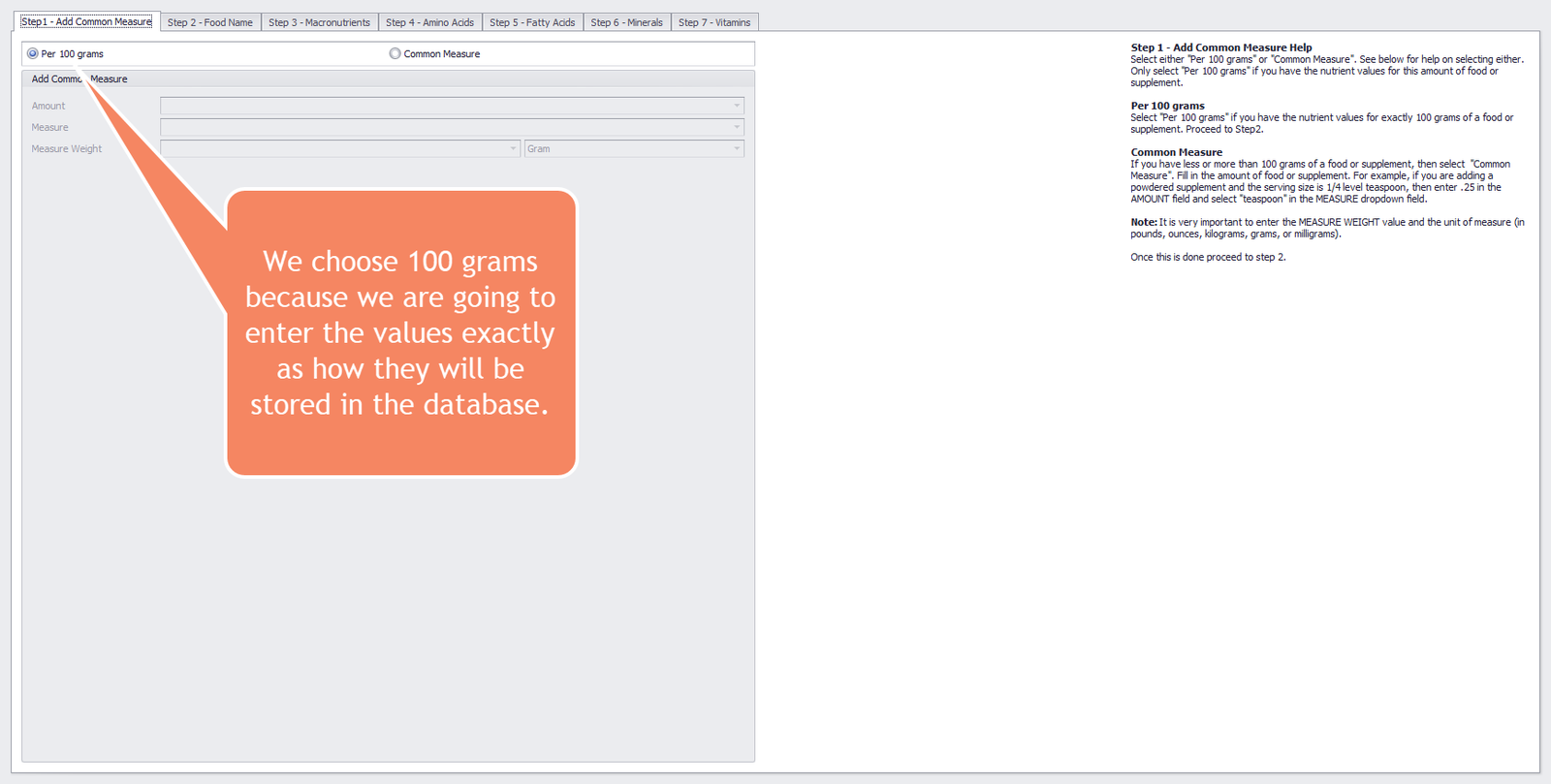
Step 1 – Add Common Measure
Step 2 - Food Name
The image below shows the second tab in the Food Wizard. The only required value that you have to enter in this tab is the name of the food or supplement. We also enter common names to help us find this supplement later.
Enter the following values:
Name = Calcium Eggshell Powder
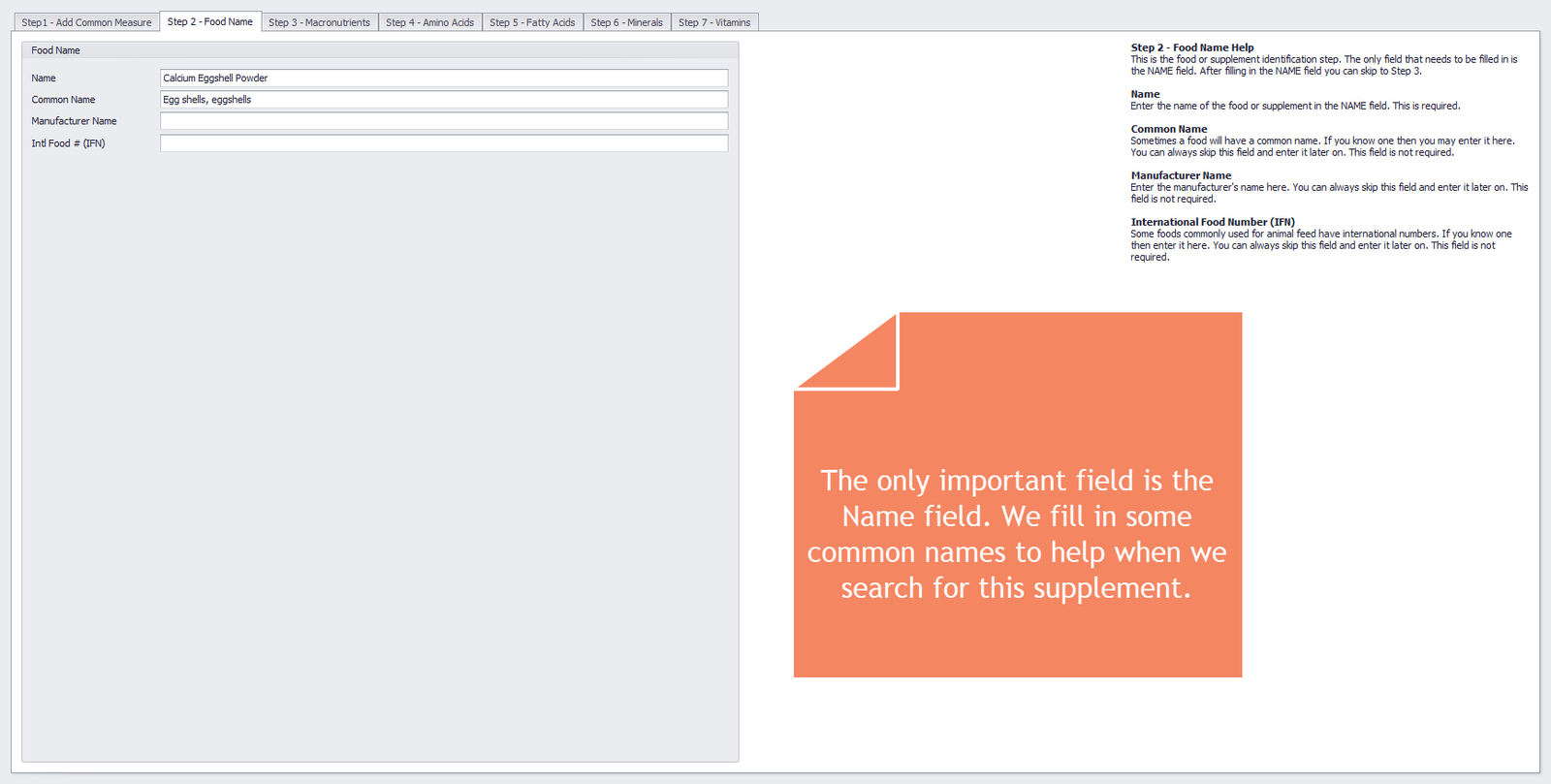
Step 2 – Food Name
Step 3 - Macronutrients
The image below shows the third tab in the Food Wizard. We don’t have enough information, so we enter 0 for Food Energy and leave the other values blank.
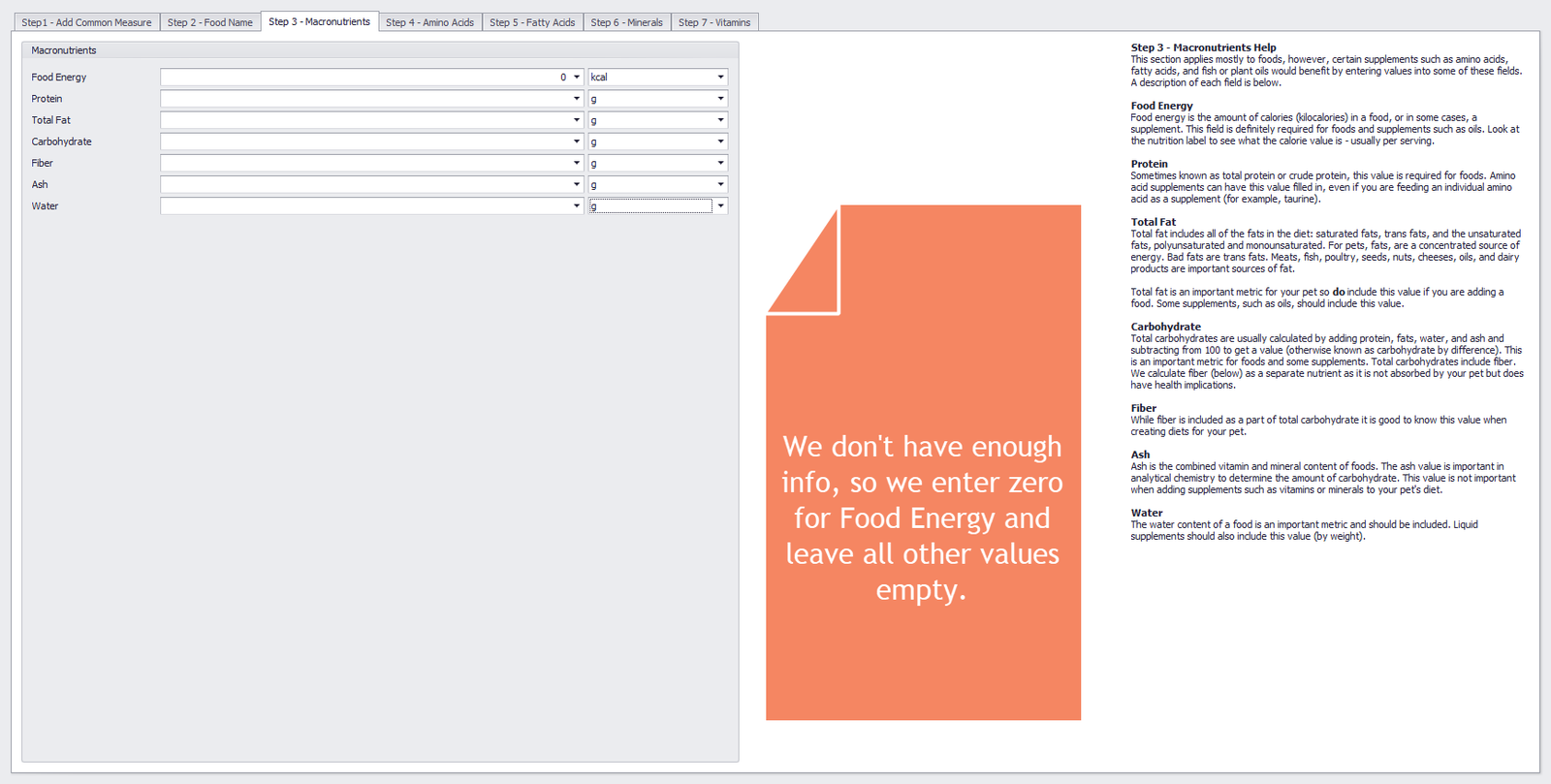
Step 3 – Macronutrients
Step 4 - Amino Acids
The image below shows the fourth tab in the Food Wizard. Since the amino acids are negligible, we leave this tab blank.
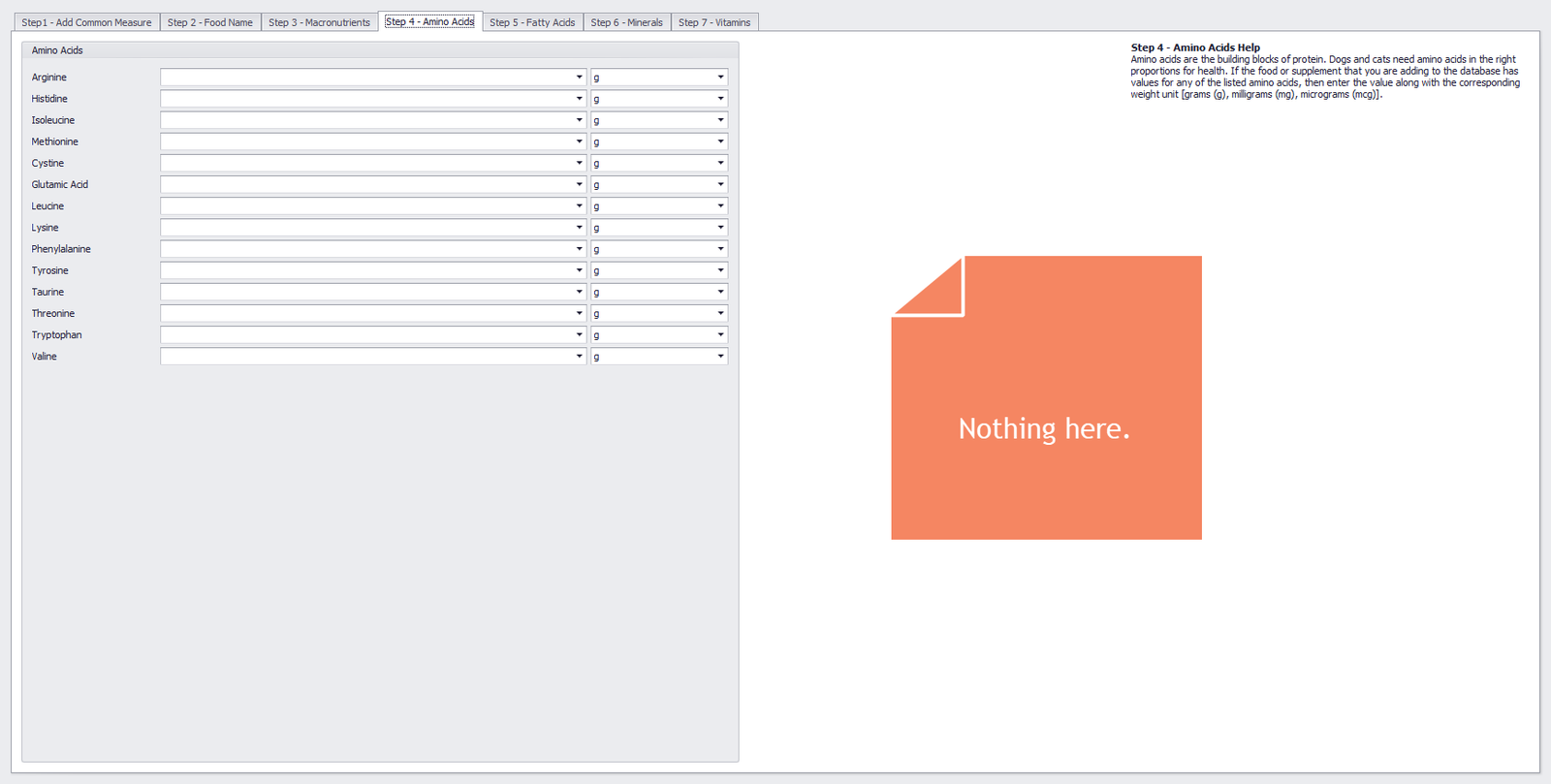
Step 4 – Amino Acids
Step 5 - Fatty Acids
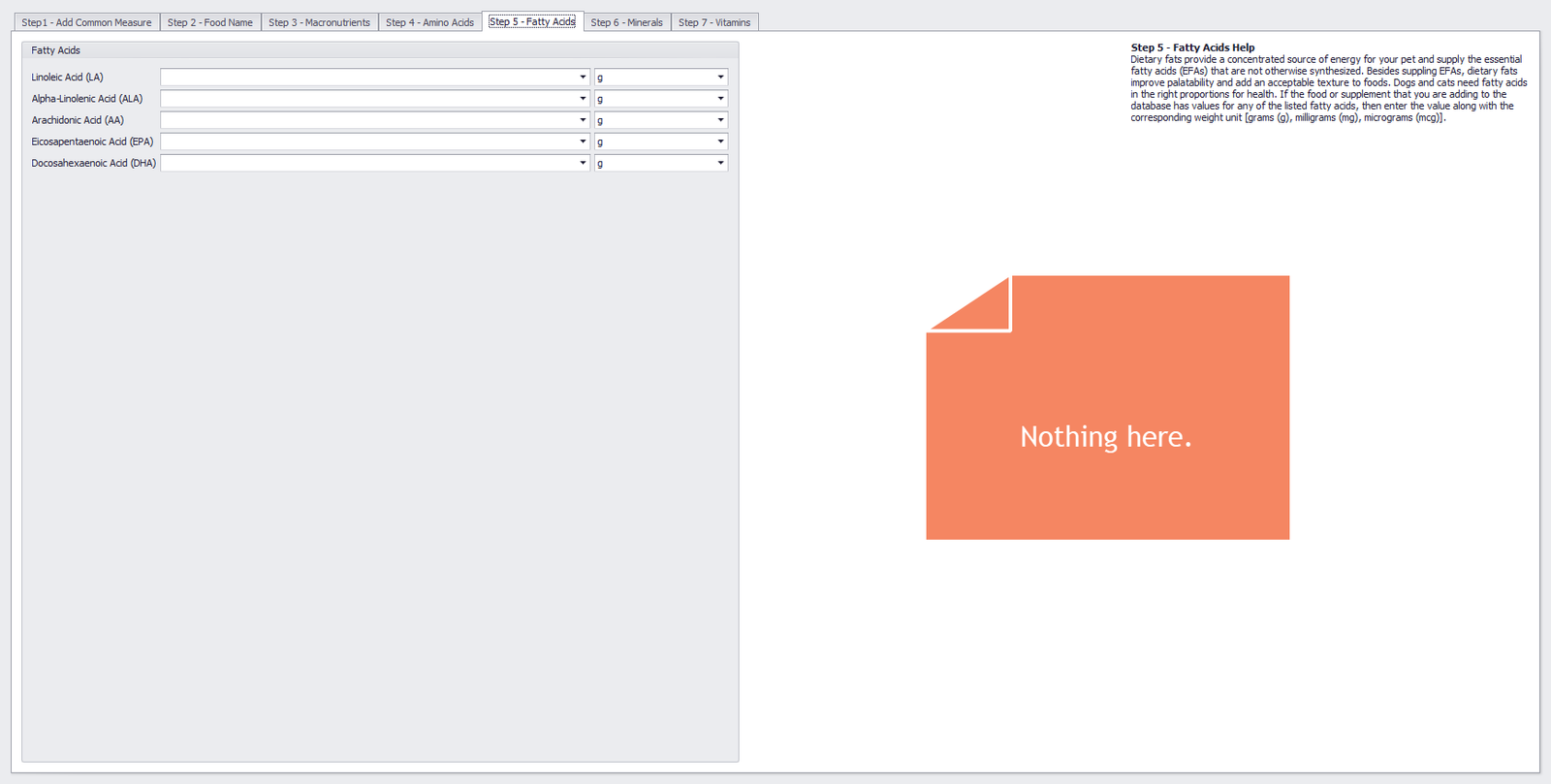
The image below shows the fifth tab in the Food Wizard. Since the fatty acids are negligible, we leave this tab blank.
Step 5 – Fatty Acids
Step 6 - Minerals
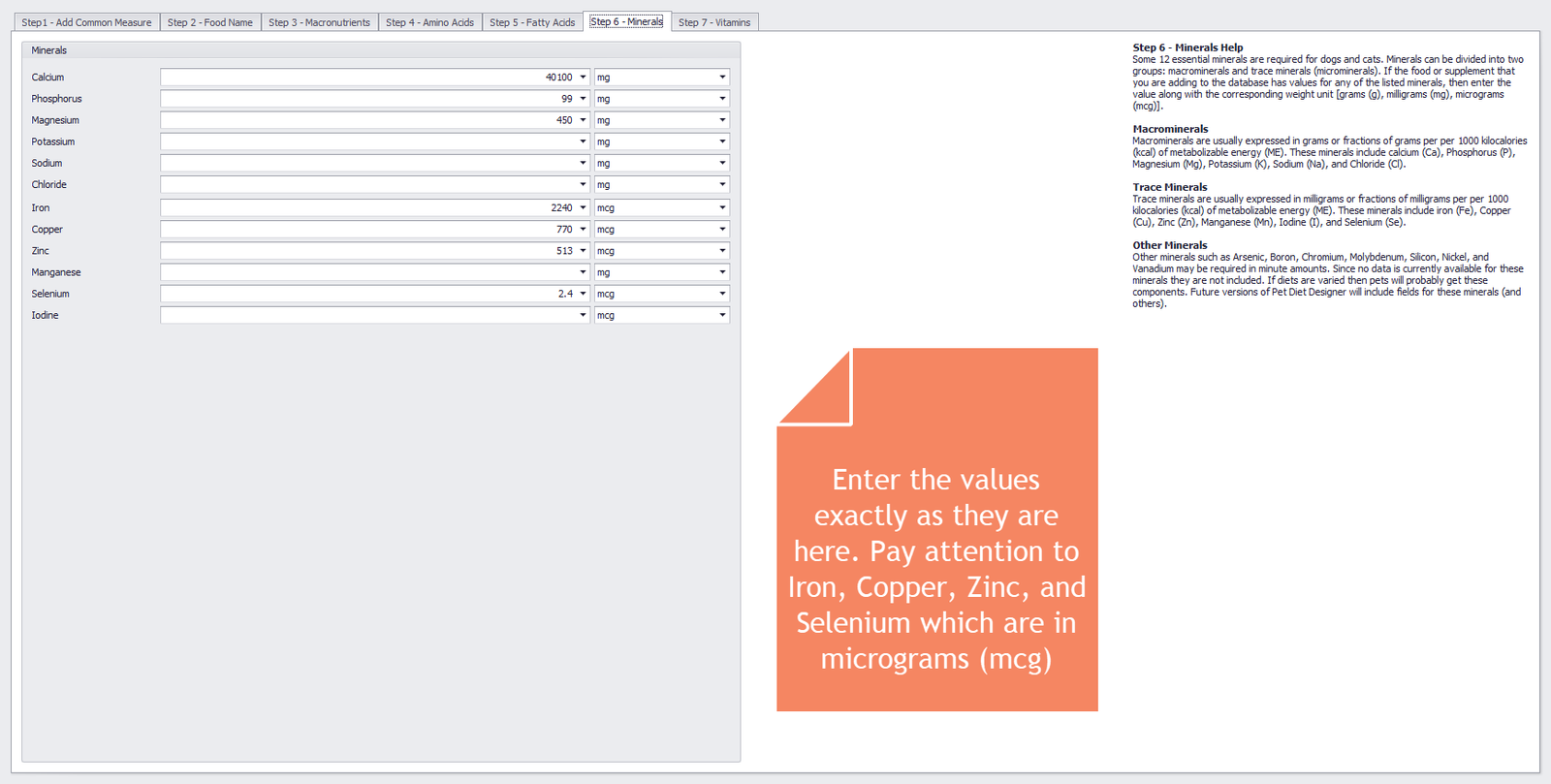
The image below shows the sixth tab in the Food Wizard. Enter the values exactly as they are listed here. Pay attention to Iron, Copper, Zinc, and Selenium, which are listed in micrograms (mcg).
Enter the following values:
Calcium = 40,100 mg
Phosphorus = 99 mg
Magnesium = 450 mg
Iron = 2,240 mcg
Copper = 770 mcg
Zinc = 513 mcg
Selenium = 2.4 mcg
Step 6 – Minerals
Step 7 - Vitamins
The image below shows the seventh and final tab in the Food Wizard. No vitamins to list, so leave this tab empty.
Step 7 – Vitamins
Conclusion
That’s it! We press the SAVE & CLOSE button on the ribbon, and the system converts and stores all values in the database as 100 grams of Eggshell Calcium Powder. Next, we will show our new food/supplement in the Foods module. Click on the FOODS button on the ribbon to open up the Foods module.
Looking at our newly entered food
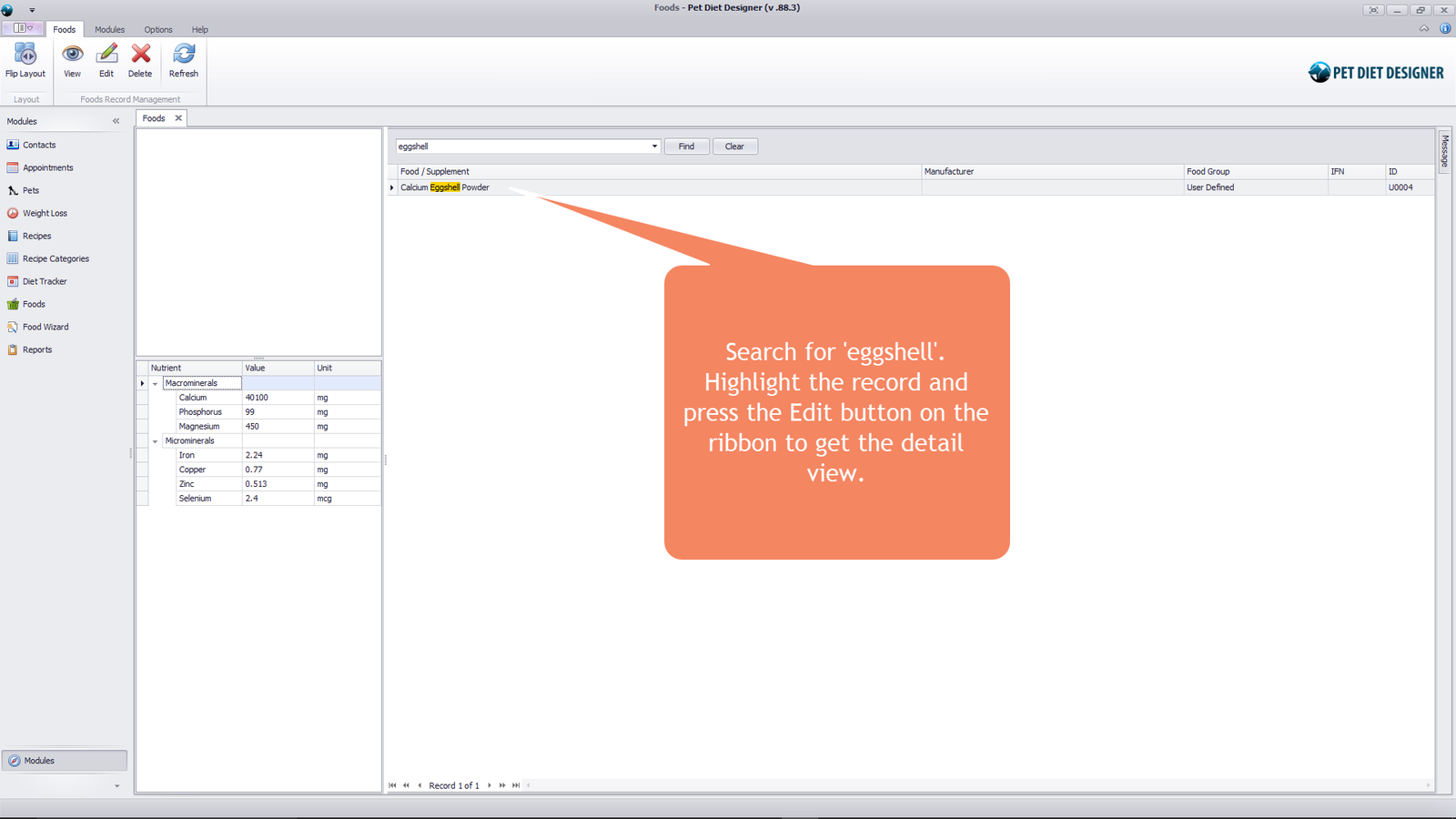
With the Foods module open, enter “Eggshell” in the search text box and click the FIND button. With the Eggshell Calcium Powder entry highlighted, click on the EDIT button on the ribbon to see our newly entered values.
Searching for Eggshell in Foods module.
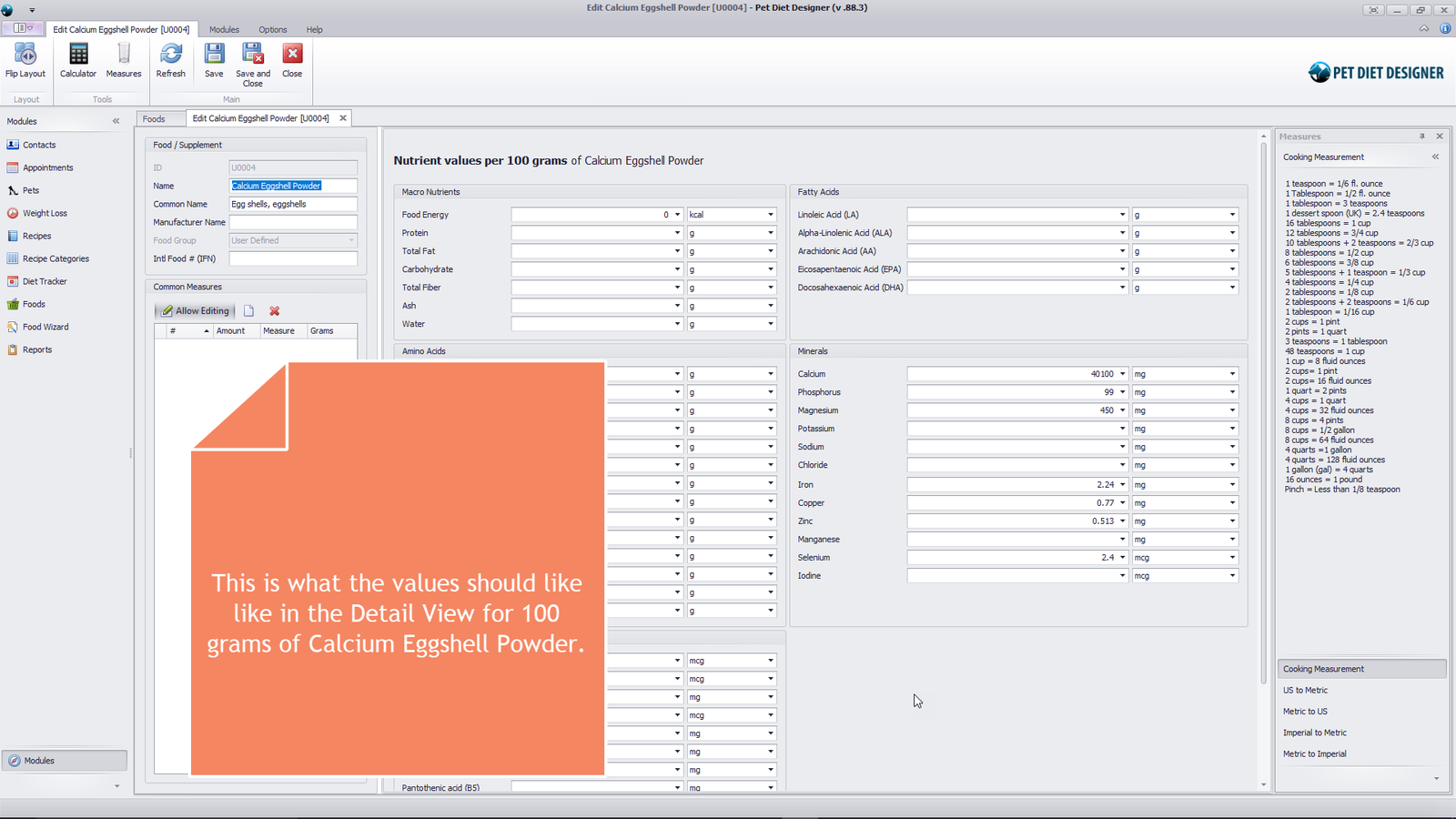
Detail View showing values for eggshell powder that are stored in the database.
Additional Notes
The composition of eggshell is very similar to bones and teeth. There are about 27 trace elements found in eggshell. We only list the most important or largest amounts for our purposes, which is to use eggshell as a calcium source. There is widely varying information on the nutrient composition of eggshells. We examined many sources and chose the source(s) most likely to be scientifically accurate.
Sources
We used the following sources to prepare this eggshell calcium tutorial blog.
1. A. Schaafsma, I. Pakan, G.J.H. Hofstede, F.A.J. Muskiet, E. Van Der Veer, Mineral and P.J.F. De Vries, Amino Acid and Hormonal Composition of Chicken Eggshell Powder and the Evaluation of its Use in Human Nutrition, 2000 Poultry Science 79:1833–1838. This is an excellent review of the nutrient composition of chicken eggshell powder and the source of the data we use for this tutorial. This publication can be found here.
2. Mohammad Aminul and Masahide Nishibori, Use of extruded eggshell as a calcium source substituting limestone or oyster shell in the diet of laying hens, Vet Med Sci. 2021 Sep; 7(5): 1948–1958. This article can be found here.
3. NutritionData, eggshell, 1/2 teaspoon. The calcium data listed on this website represents calcium salt (calcium carbonate), not elemental calcium. We do not use this data because we cannot trust the accuracy of any of the mineral values. This web page (and website) has been removed from the internet.
4. Dan Wich, Using eggshells as a source of calcium. This is a good tutorial for making eggshell calcium powder. You can find the web page here.
5. Gary D. Butcher and Richard Miles, Concepts of Eggshell Quality, Veterinary Medicine-Large Animal Clinical Sciences Department, UF/IFAS Extension. A good review of factors affecting eggshell quality and size. This publication can be found here.
6. Maxwell T. Hincke, Yves Nys, Joel Gautron, Marc McKee, The eggshell: structure, composition and mineralization, PubMed (January 2012). Fantastic review on the composition of avian and reptile eggshells. This publication can be found here.
4.5 out of 5 stars
1 rating
| 5 Stars | 0% | |
| 4 Stars | 100% | |
| 3 Stars | 0% | |
| 2 Stars | 0% | |
| 1 Stars | 0% |