
Welcome to our tutorial and documentation section for PDD Beta. Use the search box below to find answers.
-
Food Wizard Tutorials
5 out of 5 stars
1 rating
| 5 Stars | 100% | |
| 4 Stars | 0% | |
| 3 Stars | 0% | |
| 2 Stars | 0% | |
| 1 Stars | 0% |
Earth Animal Raw Complete Powder Cat & Dog Food Supplement
Are Raw Food diets complete? No! Dr. Bob Goldstein has formulated the Daily Raw Complete Powder, a nutritional supplement to add to Raw Meat diets. It combines essential fatty acids, vitamins, minerals, digestive enzymes, probiotics, and high levels of Vitamin E to provide the nutrients you need when feeding Raw Food.
Many nutrients are missing in raw dog food diets. The Daily Raw Complete Powder is designed to restore the nutrition your furry friends are missing. It features essential fatty acids, vitamins, minerals, digestive enzymes, probiotics, and high levels of Vitamin E. These nutrients will help your raw-fed dog thrive.
The benefits of feeding raw meat include healthy skin and coat, cleaner teeth, fresher breath, better weight control, improved digestion, reduced allergy symptoms, more energy, & increased mobility in older animals.
Below is a tutorial on how to add Earth Animal Raw Complete Powder to PDD Beta. This tutorial will help you add nutrients listed on the label with percentages (%), ppm, and IU/lb.
Guaranteed Analysis
Crude Protein 5.0% Min,
Crude Fat 20.0% Min,
Crude Fiber 5% Max,
Moisture 7% Max,
Calcium 1.7%,
Phosphorus 0.05%,
Potassium 0.38%,
Magnesium 0.10%,
Sodium 0.63%,
Chloride 0.15%,
Iron 850 ppm,
Copper 90 ppm,
Manganese 300 ppm,
Zinc 1600 ppm,
Iodine 100 ppm,
Selenium 1.8 ppm,
Vitamin A 98,000 IU/lb,
Vitamin D3 10,000 IU/lb,
Vitamin E Supplement 4,100 IU/lb,
Thiamin 30 ppm,
Riboflavin 33 ppm,
Vitamin B5 150 ppm,
Niacin 160 ppm,
Pyridoxine 30 ppm,
Folic Acid 6 ppm,
Vitamin B12 0.6 ppm,
Chlorine 8,200 ppm,
EPA 6.25%,
DHA 4.10%
Note: We have the Chloride value, so we will ignore the Chlorine value (8,200 ppm). We can enter all other values. See the Preliminary Calculations section below for details on the values to enter.
Ingredients
Psyllium Seed, Omega 3 Fish Oil Concentrate, Kelp, Organic Alfalfa Meal, Montmorillonite Clay, Calcium Carbonate, L-Arginine, Zinc, Amino Acid Chelate, Choline Chloride, Vitamin E Supplement, Barley Grass, Broccoli, L-Glutamine, Garlic, Iron Amino Acid Chelate, Mixed Tocopherols, Propionic Acid, Manganese Amino Acid Chelate, Copper Amino Acid Chelate, Dried Carrots, Aspergillus Oryze, Aspergillus Niger, Lactobacillus Acidophilus, Vitamin B12, Vitamin A, Niacinamide, Calcium Pantothenate, Cobalt Amino Acid Chelate, Riboflavin, Folic Acid, Bifidobacterium Thermophilum, Bifidobacterium Iongum, Enterococcus Facials, Vitamin D3, Pyridoxine HCL, Thiamine HCL, Biotin, Calcium Ascorbate, Sodium Selenite, Potassium Iodate
Preliminary Calculations
Before we enter the supplement into the database using Food Wizard, we need to do a few minor calculations. Our next update will handle these calculations automatically. The guaranteed analysis for this supplement can be used for any weight, so we will enter values for 100 grams, the amount stored in the database.
The percentage calculations are fairly easy. Each percentage will be compared to 100 grams, as in the following:
Crude Protein 5.0% Min = 5% of 100 grams = 0.05(100) = 5 grams
Crude Fat 20.0% Min = 20% of 100 grams = 0.2(100) = 20 grams
Crude Fiber 5% Max = 5% of 100 grams = 0.05(100) = 5 grams
Moisture 7% Max = 7% of 100 grams = 0.07(100) = 7 grams
Calcium 1.7% = 1.7% of 100 grams = 0.017(100) = 1.7 grams
Phosphorus 0.05% = 0.05% of 100 grams = 0.0005(100) = 0.05 grams
Potassium 0.38% = 0.38% of 100 grams = 0.0038(100) = 0.38 grams
Magnesium 0.10% = 0.10% of 100 grams = 0.001(100) = 0.1 grams
Sodium 0.63% = 0.63% of 100 grams = 0.0063(100) = 0.63 grams
Chloride 0.15% = 0.15% of 100 grams = 0.0015(100) = 0.15 grams
EPA 6.25% = 6.25% of 100 grams = 0.0625(100) = 6.25 grams
DHA 4.10% = 4.10% of 100 grams = 0.041(100) = 4.1 grams
A milligram is one ppm of a kilogram; therefore, one ppm is the same as one milligram per kilogram. So whenever you see ppm, you can just replace it with mg/kg. Since we are entering the amount for 100 grams, we will take the value and divide by 10 (1kg (1000 grams) / 10 = 100 grams).
Please see this excellent article for an in-depth discussion of ppm: http://www.nesc.wvu.edu/ndwc/articles/ot/fa04/q&a.pdf
Iron 850 ppm = 850 mg/kg = 850/10 = 85 mg
Copper 90 ppm = 90 mg/kg = 90/10 = 9 mg
Manganese 300 ppm = 300 mg/kg = 300/10 = 30 mg
Zinc 1600 ppm = 1600 mg/kg = 1600/10 = 160 mg
Iodine 100 ppm = 100 mg/kg = 100/10 = 10 mg
Selenium 1.8 ppm = 1.8 mg/kg = 1.8/10 = 0.18 mg
Thiamin 30 ppm = 30 mg/kg = 30/10 = 3 mg
Riboflavin 33 ppm = 33 mg/kg = 33/10 = 3.3 mg
Vitamin B5 150 ppm = 150 mg/kg = 150/10 = 15 mg
Niacin 160 ppm = 160 mg/kg = 160/10 = 16 mg
Pyridoxine 30 ppm = 30 mg/kg = 30/10 = 3 mg
Folic Acid 6 ppm = 6 mg/kg = 6/10 = 0.6 mg
Vitamin B12 0.6 ppm = 0.6 mg/kg = 0.6/10 = 0.06 mg
Next, we need to convert the values for IU/lb. This is trickier. First, calculate the IU amount for 100 grams. One pound equals 453.592 grams. Dividing 100 by 453.592 gives 4.53592. We divide the values below by 4.53592 to get the vitamin amounts in IU per 100 grams. We will assume Vitamin A from retinol, not beta-carotene. We will also assume natural Vitamin E (d-alpha tocopherol).
Vitamin A 98,000 IU/lb = 98,000/4.53592 IU/100g = 21,605.319 IU/100g
Vitamin D3 10,000 IU/lb = 10,000/4.53592 IU/100g = 2,204.624 IU/100g
Vitamin E Supplement 4,100 IU/lb = 4,100/4.53592 IU/100g = 903.896 IU/100g
Finally, we need to calculate the Food Energy value. We can use the protein and fat values to calculate this metric.
Energy for protein = 5 grams times 4 kcal = 20 kcal
Energy for fat = 20 grams times 9 kcal = 180 kcal
Therefore, total Food Energy = 20 + 180 = 200 kcal in 100 grams.
Summary of Values to Input
Macronutrients
Food Energy – 200 kcal
Protein – 5 grams
Fat – 20 grams
Fiber – 5 grams
Water – 7 grams
Fatty Acids
EPA – 6.25 grams
DHA – 4.1 grams
Minerals
Calcium – 1.7 grams
Phosphorus – 0.05 grams
Magnesium – 0.1 grams
Potassium – 0.38 grams
Sodium – 0.63 grams
Chloride – 0.15 grams
Iron – 85 mg
Copper – 9 mg
Zinc – 160 mg
Manganese – 30 mg
Selenium – 0.18 mg
Iodine – 10 mg
Vitamins
Vitamin A – 21,605.319 IU as retinol
Vitamin D – 2,204.624 IU
Vitamin E – 903.896 IU as d-alpha tocopherol
Thiamin (B1) – 3 mg
Riboflavin (B2) – 3.3 mg
Niacin (B3) – 16 mg
Pantothenic Acid (B5) – 15 mg
Pyridoxine (B6) – 3 mg
Vitamin B12 – 0.06 mg
Folic Acid – 0.6 mg
Food Wizard Tutorial
Below are screenshots showing the values we enter into Food Wizard. Open Food Wizard and enter the values as shown.
Step 1 - Add Common Measure
The image below shows the first tab in the Food Wizard. We choose to enter values per 100 grams.
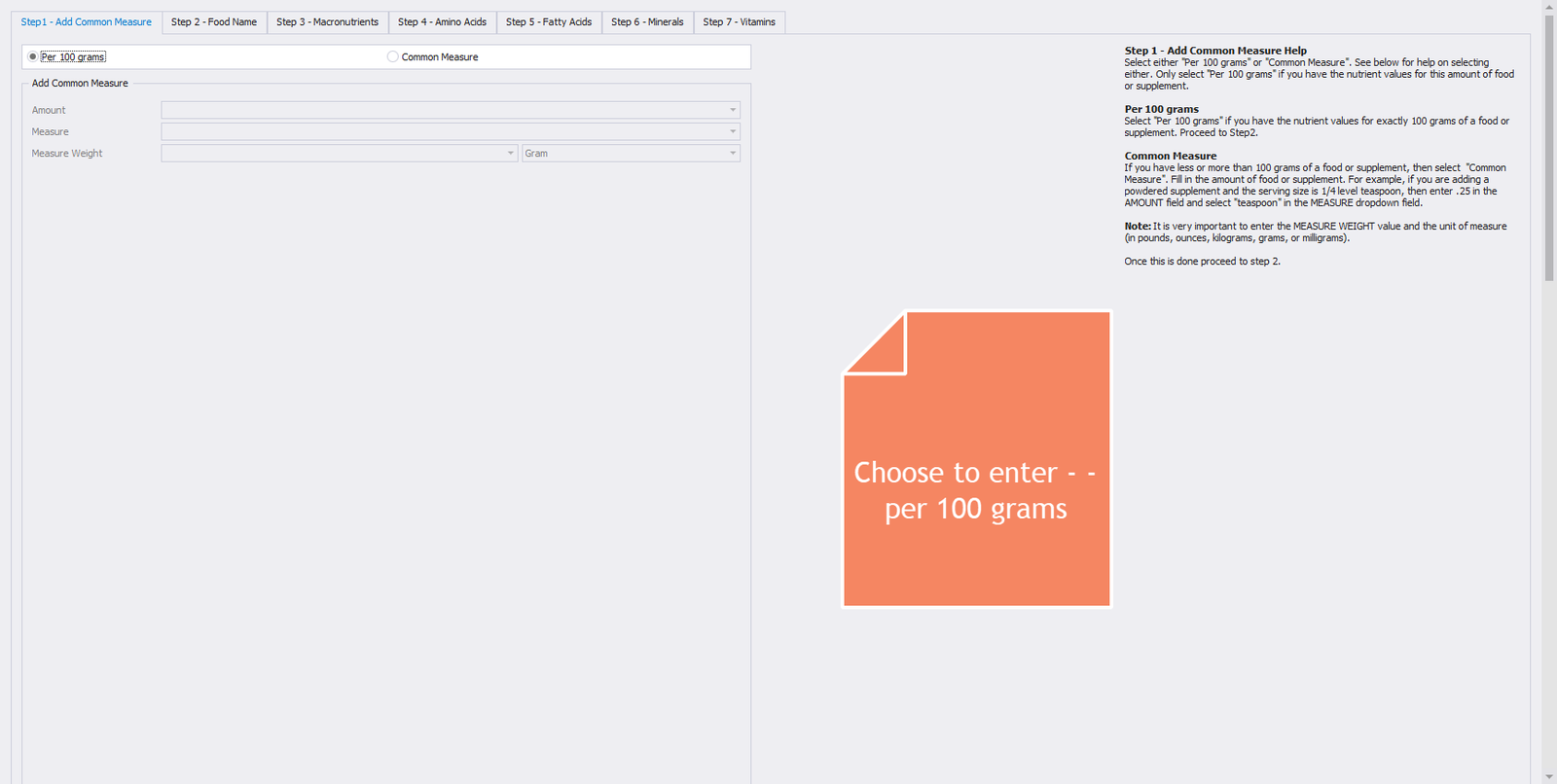
Step 1 – Add Common Measure
Step 2 - Food Name
The image below shows the second tab in the Food Wizard. The only required value that you have to enter in this tab is the name of the food or supplement.

Step 2 – Food Name
Step 3 - Macronutrients
The image below shows the third tab in the Food Wizard. We calculate the Food Energy value by multiplying the gram weight of protein and fat by the Atwater values (protein = 4 kcal per gram, fat = 9 kcal per gram) and adding the results.
Enter the following values:
Food Energy – 200 kcal
Protein – 5 grams
Fat – 20 grams
Fiber – 5 grams
Water – 7 grams
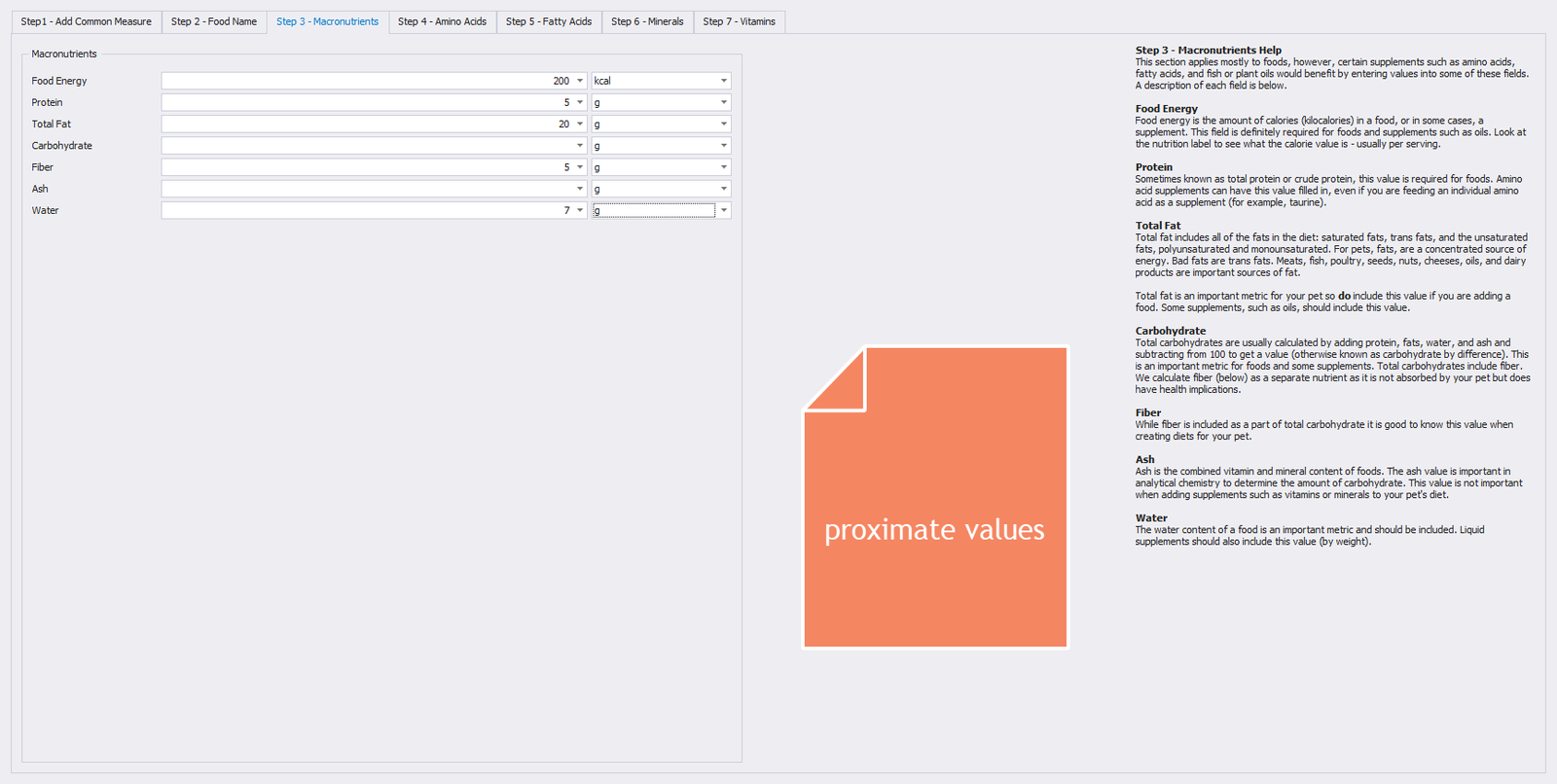
Step 3 – Macronutrients
Step 4 - Amino Acids
The image below shows the fourth tab in the Food Wizard. Since the guaranteed analysis lists no values for amino acids, we leave this tab blank.
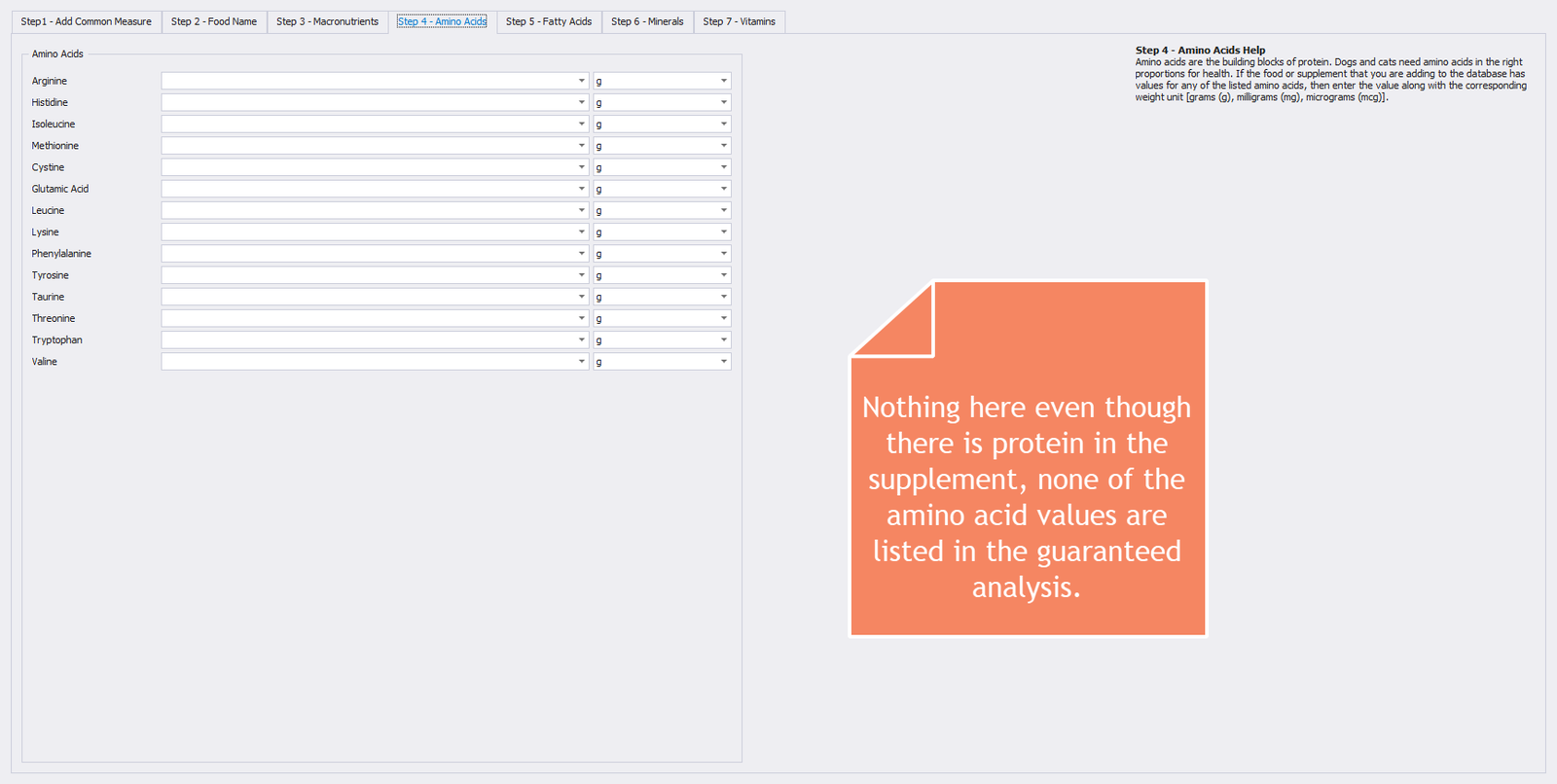
Step 4 – Amino Acids
Step 5 - Fatty Acids
The image below shows the fifth tab in the Food Wizard.
Enter the following values:
EPA – 6.25 grams
DHA – 4.1 grams
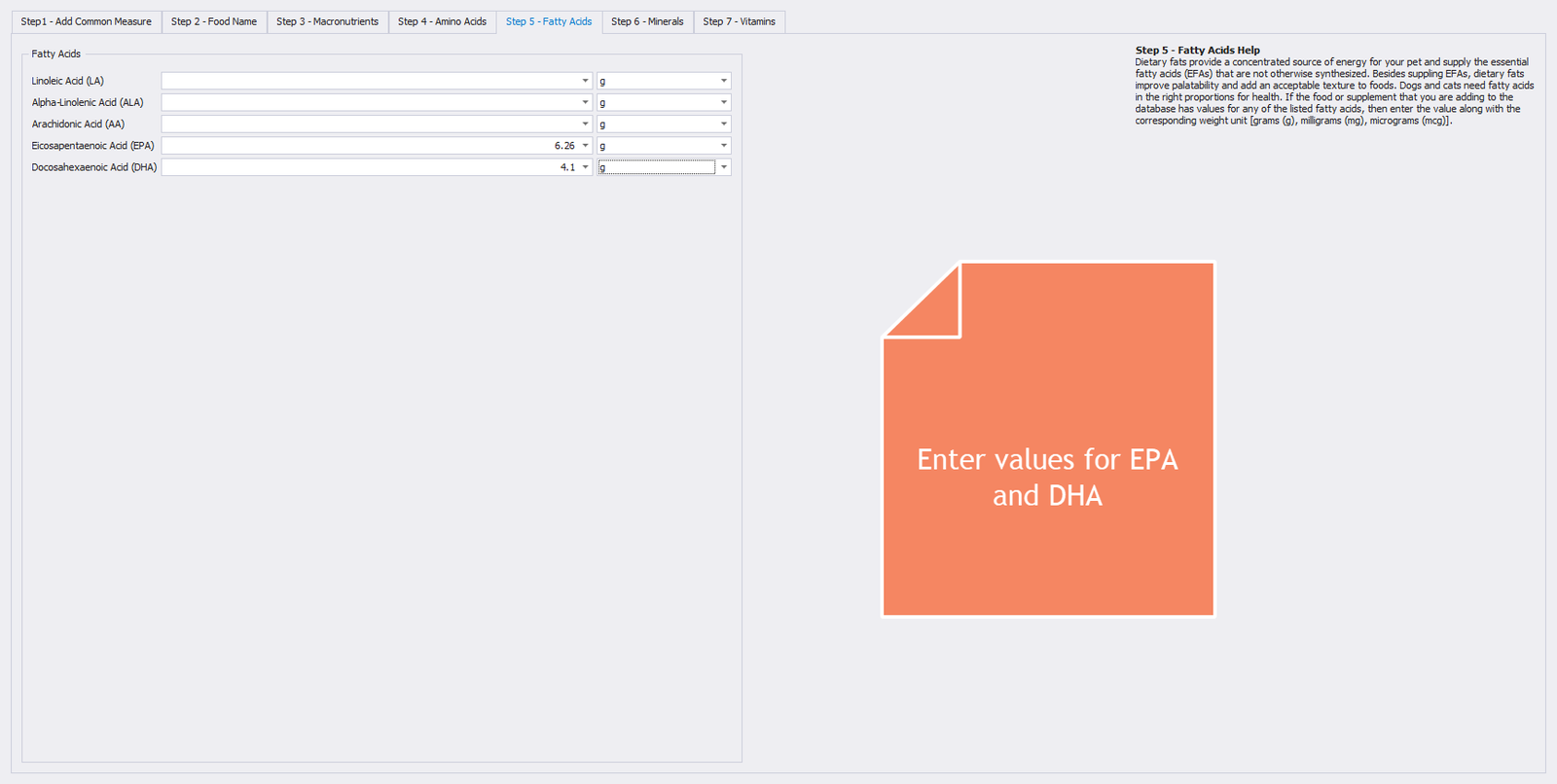
Step 5 – Fatty Acids
Step 6 - Minerals
The image below shows the sixth tab in the Food Wizard. Pay attention to the units.
Enter the following values:
Calcium – 1.7 g
Phosphorus – 0.05 g
Magnesium – 0.1 g
Potassium – 0.38 g
Sodium – 0.63 g
Chloride – 0.15 g
Iron – 85 mg
Copper – 9 mg
Zinc – 160 mg
Manganese – 30 mg
Selenium – 0.18 mg
Iodine – 10 mg
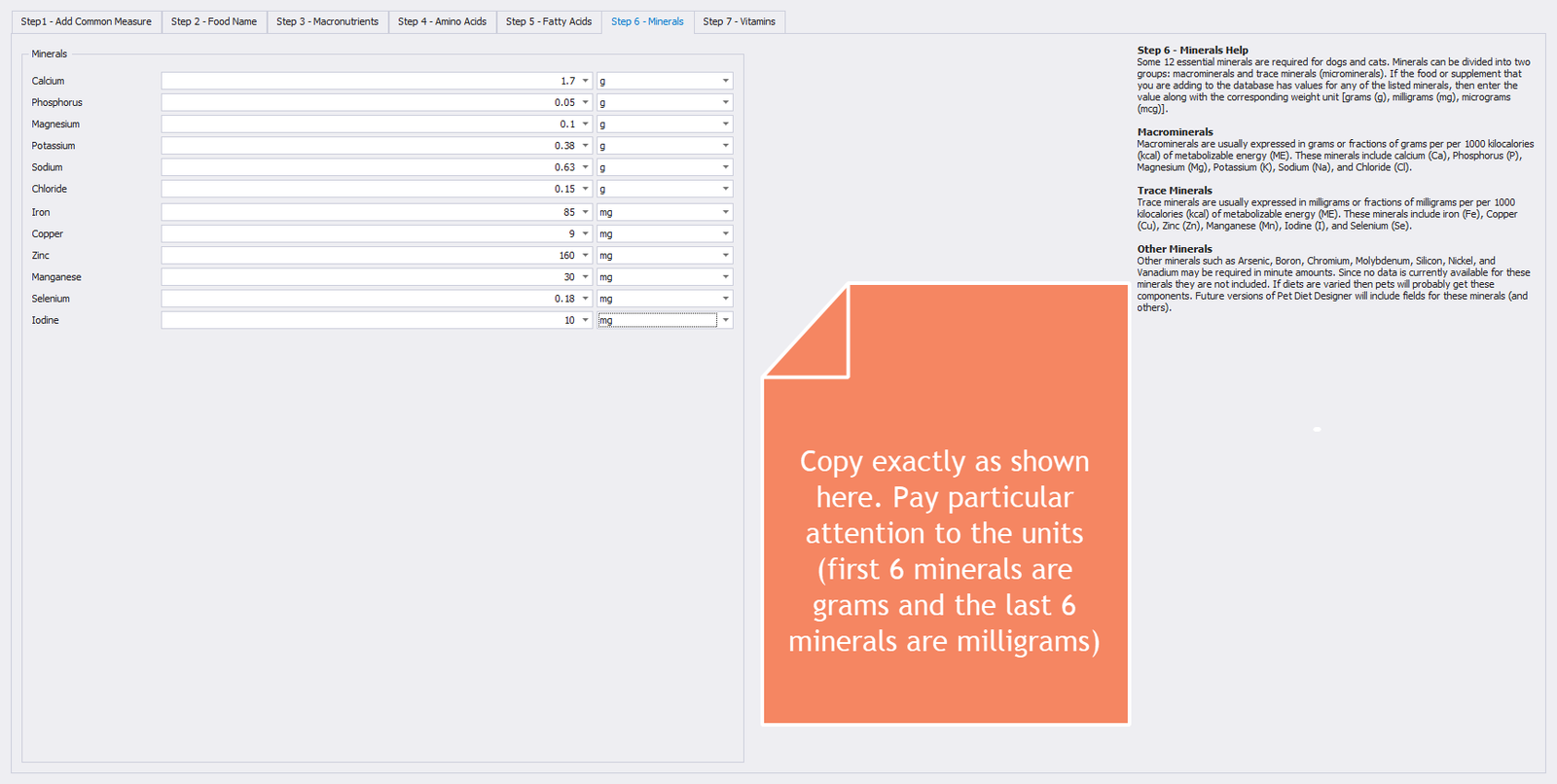
Step 6 – Minerals
Step 7 - Vitamins
The image below shows the seventh and final tab in the Food Wizard. Pay attention to the units. The Vitamin A value is listed in International Units (IU). PDD accepts values for Vitamin A from either an animal (retinol) or a plant (beta-carotene) source. We chose to enter the Vitamin A value as “IU as retinol.” PDD also accepts Vitamin E values as natural or synthetic. We chose to enter the natural Vitamin E value (IU as D-Alpha-tocopherol).
Enter the following values:
Vitamin A – 21,605.319 IU as retinol
Vitamin D – 2,204.624 IU
Vitamin E – 903.896 IU as d-alpha-tocopherol
Thiamin (B1) – 3 mg
Riboflavin (B2) – 3.3 mg
Niacin (B3) – 16 mg
Pantothenic Acid (B5) – 15 mg
Pyridoxine (B6) – 3 mg
Vitamin B12 – 0.06 mg
Folic Acid – 0.6 mg
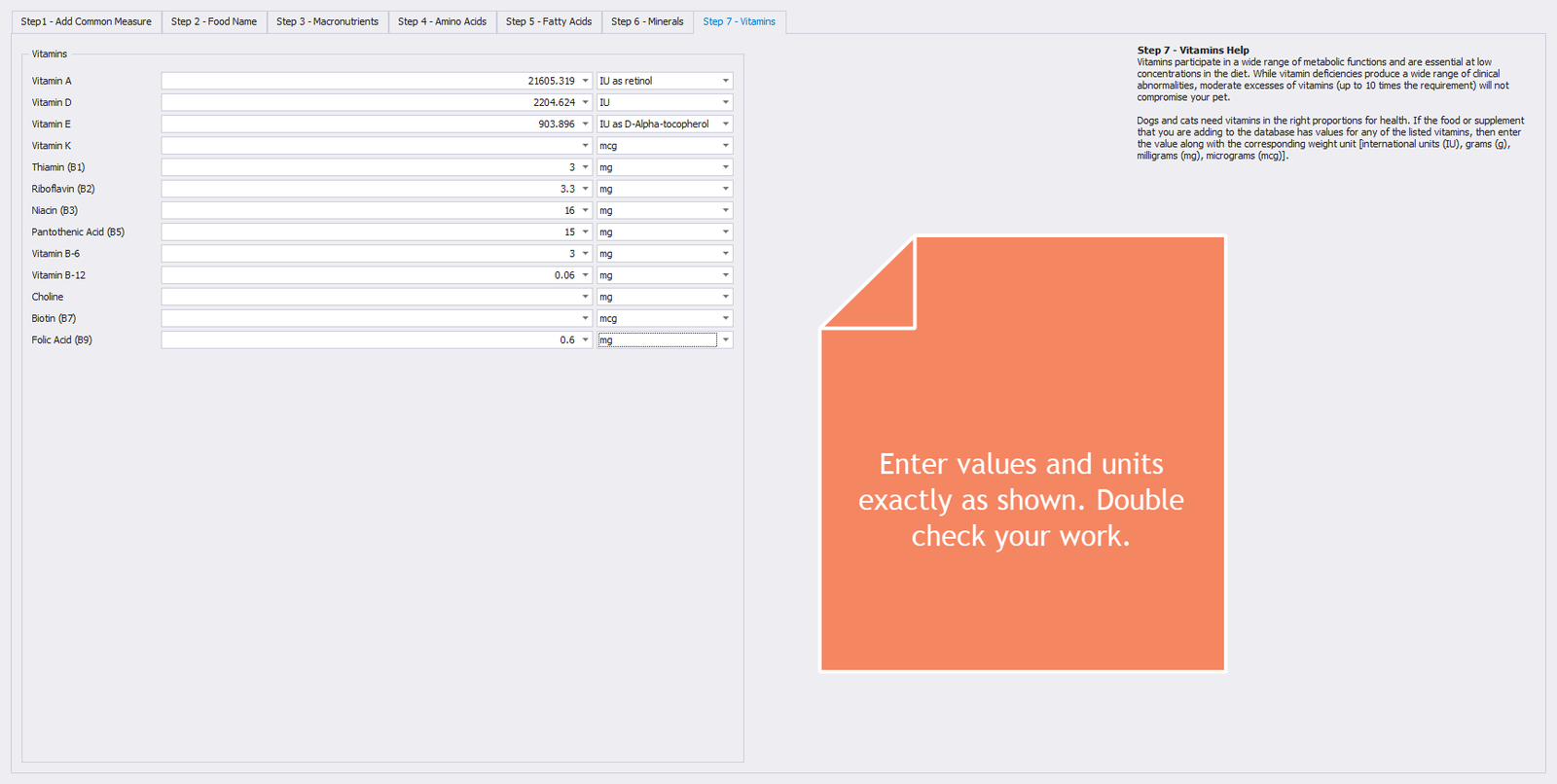
Step 7 – Vitamins
Conclusion
That’s it! We press the SAVE & CLOSE button on the ribbon, and the system converts and stores all values in the database as 100 grams of Earth Animal Raw Complete Powder Cat & Dog Food Supplement. Next, we will view our new food/supplement in the Foods module. Click on the FOODS button on the ribbon to open up the Foods module.
Looking at our newly entered food
With the Foods module open, enter “earth” in the search text box and click the FIND button. With the Earth Animal Raw Complete Powder Cat & Dog Food Supplement entry highlighted, click on the EDIT button on the ribbon to see our newly entered values.

Search for “earth” in the Foods module
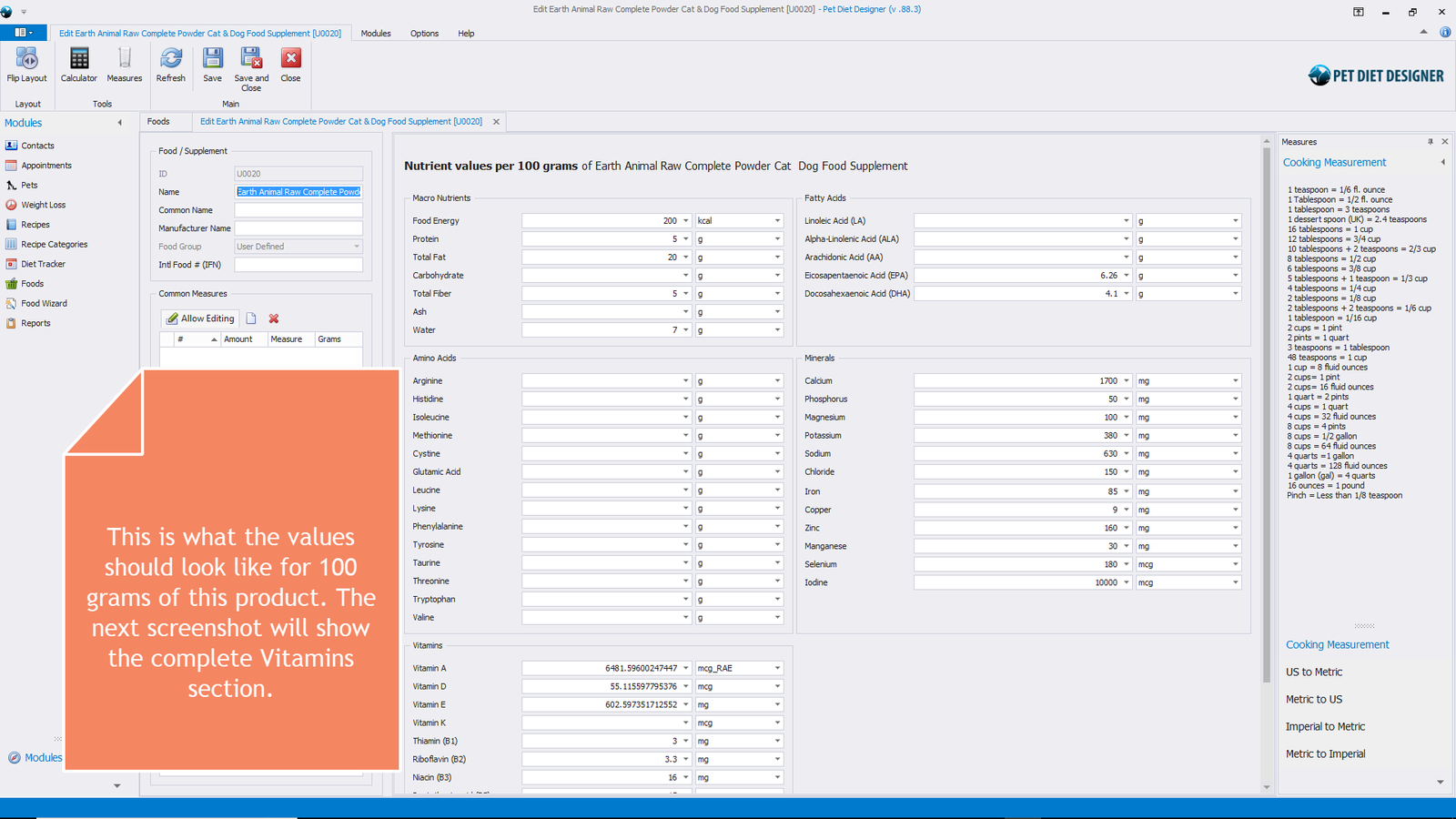
Showing the values that are stored in the database
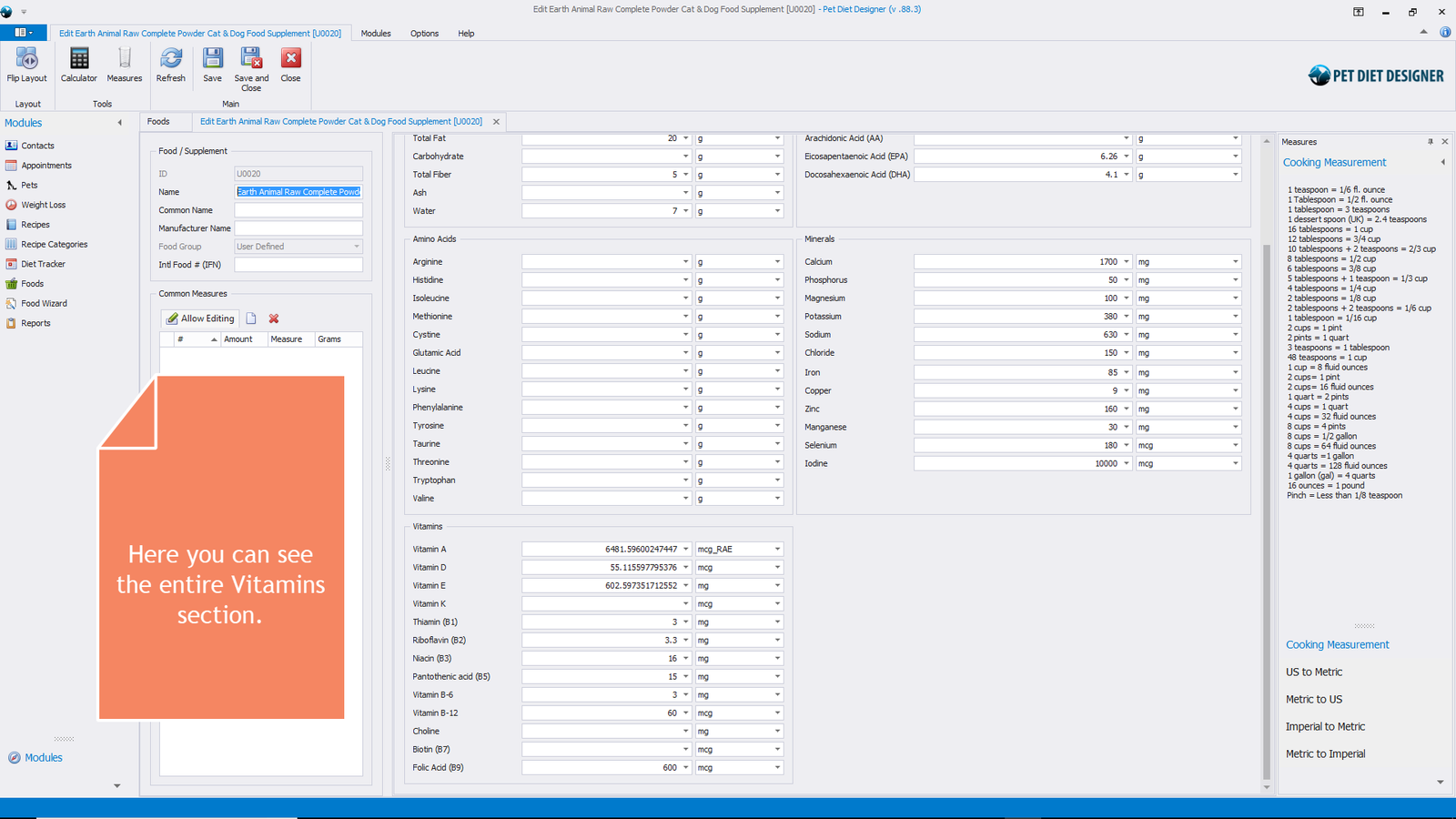
Showing the Vitamins section
5 out of 5 stars
1 rating
| 5 Stars | 100% | |
| 4 Stars | 0% | |
| 3 Stars | 0% | |
| 2 Stars | 0% | |
| 1 Stars | 0% |